A Conversation with Richard Scott
J.R. Barner
November 20, 2026
Richard Scott has given us, first with the T.S. Eliot Prize shortlisted Soho (2018, Faber & Faber) and more recently, with 2025’s That Broke into Shining Crystals, nothing short of a master class in poetic form. More akin to painting, whose lexicon Scott borrows from for the first of the three parts of the collection, these are “still lives” captured in medias res and transcended beyond the realm of “things” and into all the soft, sticky, fleshy stuff of life. The second part, ‘Coy,’ has its way with 17th century bard Andrew Marvell’s ‘To His Coy Mistress’ and I, for one, wouldn’t have it any other way. Concluding with the gemstone-themed meditations that give the book its title, Scott examines the truth found in the broken and the courage in the act of fixing. In reading these solemn, sensuous meditations, one is immediate brought to consider the relationship between trauma and transcendence, in particular through the ancient Japanese art of kintsugi, or fixing the pieces of a beloved plate or cup with gold. What emerges is something more beautiful than its former form or the broken pieces whose scars still show. With this current collection, Richard Scott fills the gaps with golden words on the shattered pieces of the human heart. In this conversation, we dig even deeper into the soil of life, love, the spectral and the all-too-human.
J.R. Barner: Thank you so much for taking the time to speak with me. Let's start with something I'm always curious about when I think about poets I admire: What was your first memory of poetry? How does that moment continue to inspire you today?
Richard Scott: Oh, this is such a great question! It immediately makes me think of that anthology of war poetry, Up the Line to Death, which I studied as part of my English G.C.S.E. Maybe that constitutes some of my earliest poetic memories — being fifteen and taking apart these poems full of violence and protest and, as I'd later find out, encoded queerness. I had a hard time with poetry at school though, and I think many people do, as we're taught that to get good marks you need to be able to fully understand every part of the poem — and ultimately, I think that kind of grappling for complete sense, and marks, is detrimental. But I think my first fully resonant and instructive memories of poetry were really at music college, where I was studying opera singing.
In French song class I learnt these songs by Gabriel Fauré, Claude Debussy and Reynaldo Hahn which were settings of Paul Verlaine's poetry. And getting the opportunity to study the French, in terms of pronunciation and phonetics, as well as meaning, was incredibly important to me. I started to see the poem as a soundscape of sorts; one filled with echoes and arranged repetitions. I also started to understand that the poet is a singer who sings in language. And I started to realize just how related the song and the poem are — they're both intense hotboxes of organized sound and lyric feeling. Verlaine's 'Clair de lune' is still one of my favorite poems for these reasons. And Verlaine is one of my queer ancestors — he's taught me so much about queerness and language and sound. He continues to haunt me.
JRB: Sassoon and Owen, especially, were also touchstones to me, both in terms of just how visceral they were, and yet, so tender. And you've read my mind, talking about music. Something I immediately noticed in Soho was the collection's musicality. I could hear music in my head every time I started to read. The Verlaine sequence crashes and crescendos like the chorale in a Verdi late-period work like Don Carlos. Hearing an 1867 opera in my head whilst reading about Grindr and Tinder, I told myself it shouldn't happen, but it did, and it was glorious! Similarly, I can't help but read 'Public Toilets in Regent's Park' in the voice of Neil Tennant from Pet Shop Boys, and 'Oh My Soho!' pulsates with old school house music, to me, even now as I'm writing this at an altogether reasonable (and very un-house-like) hour of the afternoon here in the States. In Soho, there are those moments of violence, fear, and shame, but also love lust, longing, and a celebratory sense that permeates it all. It makes me wonder: Are there musical moments in your work? Do you listen to music while you write?
RS: Music is so important to me — it's such a powerful facet of the lyric — so I am always trying to get music into my lines. Reading the work aloud and having a sonic edit feel like an important part of my process. I suppose there's a kind of deep listening going on. Listening and dictation, and then a listening and modulation. But it all began with opera — learning arias by Handel, Monteverdi and Gluck — and having those melodies and harmonies live in my body, so it would make sense that they'd reconstruct themselves within the text. And spending so much of my life going to Soho — well Soho is a deeply musical place; as you walk between bar and pub and cafe the music spills out onto the street and attracts, complicates, darkens and sweetens. So, I am sure there's opera in my collection Soho alongside the cadences and melodies from pop, house and electroclash too. I do listen to music whilst I work — mostly opera these days — and I think this helps strengthen my belief in the sonic complexity of language. It also helps me to reconnect to a mood, sensibility or lyric feeling that the poem might be operating within. It also just reminds me to always consider music. Mei-mei Berssenbrugge refers to each poet having a 'private music' and I suppose this might be mine — the cadence of Baroque opera fused with the soundtrack of Soho nights.
JRB: Music and art, in Soho and That Broke into Shining Crystals, stand so prominently, like gates of horn and ivory between a real and ideal queer subjectivity. From a reader's point of view, I wonder what role, akin to the musical in Soho, that art (from the paintings of 'Still Lifes' to the gemology of the title sequence) plays in your daily life, that so informed That Broke into Shining Crystals? Where would you place yourself in art, or art in yourself? Do you paint? Collect crystals? Are you a regular museumgoer? Do you frequent galleries? Your work is often so visually informed and so cinematic that I sense, just from reading works like "Still Life with Rose," "Still Life with Cornflower," "Lapis Lazuli," and "Selenite," that there must be a deeper, more visceral connection.
RS: I absolutely am a museumgoer! Maybe I have been my whole life. I still remember being taken to the V&A by my dad on a Sunday. My sister, brother and I would groan around the plaster courts lamenting how we weren't allowed to watch TV instead. But now I'm just so glad that my dad introduced this idea of looking intensely at something, it's been a massive companion and source of joy to me my whole life. But my museum visits stepped up when I was writing my poems in dialogue with still life paintings. I spent time in so many museums sitting in front of paintings trying to look intently and understand the vibe and their encoded messages; I wrote the first drafts of all of those poems in front of canvases, and the initial drafts were really maps of my mind as I looked closely at the fly on a petal or the texture of a shucked oyster or a single grape lit from within. In this way I wanted to challenge the idea of looking away from something intense, which is what we often do when faced with something overwhelming and beautiful. I wanted there to be no safe retreat from the shocking rectangle of paint — and in response to this looking, I kept experiencing lyric revelation or the lyric wound being opened. I found out what was underneath the stillness and the symbols.
I wonder now if there might be something queer in that kind of intense looking. Maybe it reminds me of a kind of cruising gaze which emotes desire, longing and, ultimately, a need for understanding or to be met. I do collect crystals — and, again, looking closely into them when I was writing the crystal poems was super helpful. I mean looking at any concrete object can be helpful when writing as it reminds you to give your poems heft and body. But there was something so important about seeing the variety of shocking colors emanating from a crystal, and to clock how these change in various lights. I also love how the crystal contains and represents so many different types of wisdom — geological, esoteric, mystic, hermetic, spiritual etc. — and how it seems to change the world around it by its presence or subtle vibrations. I think that there's something important about trying to enter into the atmosphere, or vibe, of a crystal or an artwork. That's part of the work of writing, maybe. If you can somehow glimpse it, the world opens, via language, anew. I used to paint when I was a teenager; I loved it. But that gave way to music which gave way to poetry and now my access to art is mostly sustained by the National Gallery being free. I just saw the Francisco de Zurbarán show there last week and was so shocked by the rinds of his lemons. They are so textured and rippling with life. They exemplify one of the big tensions of the still life painting — still yet so very alive, vibrating and somehow full of motion.
Art is central to how I experience the world. It helps me realize things that I am feeling before I have admitted them to myself. What the lemons will come to mean is yet to be uncovered but already I feel a kind of interest and grief. Maybe the lemons tell me that I am getting older. Maybe they're bright yellow glimpses of death, or rather what might be beyond death. I don't know.
JRB: This idea of ‘beyond' leads right into what I think is one of the most striking elements of your work: the recurring theme of legacy, community, or a kind of afterlife, something past but omnipresent. You spoke before of ancestors, and that word describes this sense of place or populace perfectly! For a reader whose own experience of home, of family, and of acceptance is often fraught with painful memories, there is such tremendous solace to be found in your poems, as they are located in (or as) a transcendence, and populated (often literally, with their own words) by these forebears, be they poetic (Whitman, Larkin, Verlaine, and Doty in Soho, Marvell, Rimbaud, and Ashbery in That Broke into Shining Crystals) intellectual (Freud, Sedgwick and Foucault in Soho, Berger and Lacan in That Broke into Shining Crystals) or, of course, artistic (all of the wonderful paintings and painters referenced in the Still Life poems). So, tell me about them! Specifically, what attracts you to these figures? What effect do they have on the poems and vice versa? While not always so, could they be considered a kind of "queer pantheon" or "ancestry," albeit with all the attendant inverted commas?
RS: Ancestry is fundamental to my practice. I am hungry to uncover the wisdom that my queer ancestors might have for me. And my writing is a way of addressing them and listening for a reply. It's a kind of speaking back to, I suppose. My crystal poems are an example of this. They began by repeated readings, both conscious and unconscious, of Arthur Rimbaud's Illuminations. At some point I began to realize that Rimbaud was speaking to me through the crystal — crystals, semi-precious stones, crystalline light are everywhere within those poems. I became convinced that Rimbaud was prompting me to investigate the crystal as an object, or symbol, and nexus of languages — geological, spiritual etc. And I suppose the question I had been holding was something like, what are the languages we might use to sing about trauma and hurt if we don’t have access to straight-forward, normative language or expression.
And Rimbaud answered and somehow, I was able to listen and then write accordingly. The same happened with Paul Verlaine’s poetry – immersing myself within his language and form helped me to resee and better understand London's Soho, and to feel less alone during its hyper-gentrification and policing. I think there is a queerness to this technique – connected perhaps to the 'painful memories' you mention – it's a reaching out for ancestry, to experience the unbroken line of queerness and queer artistry beyond family and heteronormativity. Perhaps queer people are called to create, or understand, their lineage in a non-traditional, or poetic, fashion. Section 28 made me hunt for mine and it was there waiting in the local library in the form of Gerard Manley Hopkins, Walt Whitman, William Shakespeare, Emily Dickinson etc. – queer texts that somehow evaded the Conservative government’s censorship. Things might be a little different now. There are more queer artists able to use their queerness to create, openly. But I think the idea of finding and listening to ancestors goes to the heart of poetry and language itself. All languages are, in some sense, found and have been used before multiple times. I want to celebrate this strange and generative occurrence and find my language in queer places.
There's this line from Denise Riley’s poem ‘Listening for Lost People’ — 'the souls of the dead are the spirit of language' — which I just adore and I think speaks to your idea of an afterlife. If there is one, it's in language, and we can go there if we listen. The transcendence, time travel or necromancy of using a word sung by, say, Emily Dickinson – for instance ‘Attar’, ‘Amethyst’, ‘Astral’, ‘Adamantine’ — is thrilling and one of the reasons I write. It’s a kind of channeling I suppose.
JRB: There's so much to what you said about language as afterlife, but also language as living—something in the now, the mercurial present pushed and pulled by possible pasts and futures. I wonder if your channeling, for example, informs your teaching at Goldsmiths and the Faber Academy. As creators, we're often called upon to perform our traumas, to exorcise them through our work, but also, in the demonstration, to show others that ways of expression are possible. I think of the role that community plays in that: our ancestral community, and the community of spirits, as Riley might describe them, but also the queer communities that exist—the families we choose, for example, the mentors who crawled so we could run free. I'm wondering if I could hear your thoughts on community. On the possible roles that the poetry community, the queer community, and the creative community play as conduits to your poetic practice and output. How do you choose to build community into your work? And, in turn, how does your writing inform your community?
RS: The thought of you reading Denise Riley brings me so much joy! And actually, is a beautiful example of poetic community – the knowledge, ideas, reading lists we all share between us strengthens and enlarges our collective thinking! So many discoveries and voices are out there for us all to read; maybe for this reason The Poetry Library on the Southbank feels like one of my favorite community hubs; there you can bump into both the living and the dead in the stacks! And you’re so right – language is also utterly alive and pulsating with usage and speech! It’s so momentary and current, as well as being ancient and an afterlife of sorts. The English language is constantly evolving and consuming new words, ideas, lexicons, other languages, slang etc. And queer people too are constantly reviving, revising and reinventing words. Just think of the usage of the word ‘queer’ over time – something broken, forked, strange — becoming a sexuality, a type of theory, politically-activated, a mode of being etc. Your question is also very timely as I’ve been thinking a lot about the poetry workshop recently. My workshop – FACES, which is named after a nightclub in Romford by Hannah who started the workshop — has recently become very active again; I suppose because we’re all working on a project and are hungry for feedback. And the UK is full of poetry workshops – thousands of poets sharing work in this way and continuing. (Poetry, I believe, is born of this continuation). And I’m fascinated by the poetry workshop – how it can be like a shared consciousness sometimes, able to collectively hold complexity and nuance — but also deeply rhizomatic; growing sideways and connecting to different voices, opinions, ways of seeing the poem, references. There are four poets in FACES but together we can access and share all of our learning and thinking. The workshops in the UK all reach out to touch each other in unexpected ways. Both of my books were born of community — both poetic and queer and the Venn diagram of the two; someone said to me recently, at a reading, that they’d read the notes at the back of my second collection and were moved to see the names and conversations I reference in there. My friend Emily bringing me three white roses. My mentor Daljit telling me that ‘the life of the victim is still a creative one’, which just became such a generative idea for me. My godson Isaac thinking he saw a unicorn. Community helps me create or, to borrow Derek Jarman’s words, to ‘live in creation’.
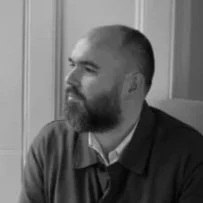
Richard Scott was born in London. His pamphlet Wound (2016) won the Michael Marks Poetry Award in 2016 and his poem ‘crocodile’ won First Prize in the Poetry London Prize 2017. His first book Soho (2018) was a Gay’s the Word book of the year and was shortlisted for the T S Eliot Prize, a Costa Book Award, and a Forward Poetry Prize. His poetry has been translated into German and French. He is a lecturer in creative writing at Goldsmiths, University of London, and he teaches poetry at Faber Academy. His latest collection, That Broke into Shining Crystals (2025), was a Poetry Book Society Choice.
J.R. Barner is a writer, teacher and musician living in Athens, Georgia, USA. They were educated at the University of Minnesota and the University of Georgia. They are the author of three chapbooks and two collections, Little Eulogies (2023) and The Ocean Underground and Other Poems (2025). Their free-verse novella, The Solent, will be published in 2027.